
Written by Philip Solomon and Anna Pilipiuk, Head of Growth Strategy and Product
Key Takeaways
1. An orchestration layer solves an access problem, not a data problem. It gives users one place to ask questions and trigger actions across ERP, source-to-pay, contract and finance systems. What it does not do is fix the underlying data. A layer sitting on poor spend data will return confident, wrong answers faster than a human ever could.
2. You are buying a second stack, and part of the bill is variable. Implementation and maintenance of the layer sit on top of the systems you already pay for, and token consumption scales with usage rather than seats. Most procurement business cases model licence cost accurately and running cost badly.
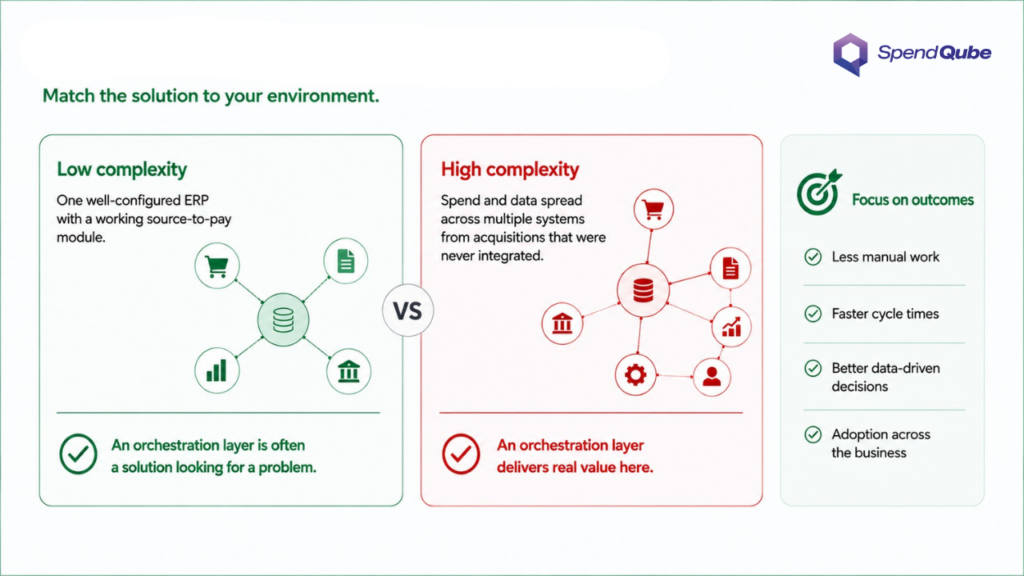
3. The honest test is complexity, not capability. If spend runs through one well-configured ERP with a working source-to-pay module, an orchestration layer is often a solution looking for a problem. If it runs across a dozen systems from acquisitions that were never integrated, the case is much stronger.
AI orchestration is the layer that sits above your existing systems and coordinates them. Instead of a buyer opening the ERP for a purchase order, the contract repository for the terms and a spend tool for supplier history, they ask one interface and it works across all three, retrieving data and triggering actions on their behalf.
Procurement is taking it seriously. The Hackett Group’s 2026 Procurement Key Issues research found that 80% of procurement executives now rate AI-enabled technology as the most transformational trend facing the function over the next five years, with workloads projected to rise 8% in 2026 while headcount and operating budgets fall. On architecture, Hackett’s Procurement Adoption Index reports 65% of leaders prioritising orchestrated workflows over standalone point agents.
That is the direction of travel. It is not, on its own, a reason to buy. Here is how to work out whether you need one.
The case for a layer: one door into many systems
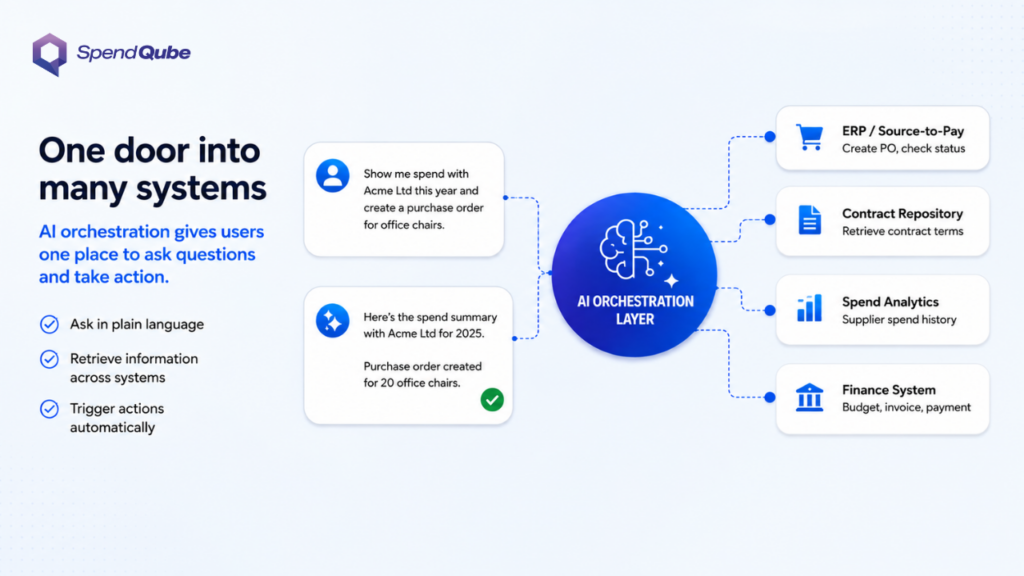
The core benefit is simple and real. End users stop logging into multiple systems to complete a single task.
A chat-oriented interface also lowers the learning curve. Procurement software is notoriously under-adopted because it requires people to know which screen does what. If a requester can describe what they need in plain language and the layer routes it, training burden drops and so does the workaround economy of spreadsheets and email approvals that grows up around hard-to-use systems.
The second benefit is the elimination of manual keying. Much of what procurement teams do between systems is transcription: copying contract terms into a sourcing event, re-entering supplier details, pulling numbers into a report. An orchestration layer handles a large share of that, which is where the time savings actually come from.
The case against: you are buying and maintaining two stacks

The cost picture is where business cases tend to fall apart, particularly where the capability is not native to the ERP.
You are carrying three costs, not one. The implementation and maintenance of your existing systems continue unchanged. On top of that sits the implementation and maintenance of the orchestration layer itself. And on top of that sits consumption: the token cost of every query the layer processes, which scales with usage rather than with licences.
That third cost is the one procurement teams underestimate, because it behaves unlike any software line they are used to. A seat licence is predictable. Inference cost rises with adoption, which means a successful rollout can be the thing that breaks the business case. If you are evaluating a layer, model the running cost at full adoption rather than at pilot volume, and get contractual clarity on how consumption is priced and capped.
Gartner’s June 2025 forecast that more than 40% of agentic AI projects will be cancelled by the end of 2027 names escalating cost and unclear business value as the first two causes. Neither is a technology failure.
Do your current systems already do this?
This is the question to answer before any vendor demonstration, and for many organisations it settles the matter. It is also worth asking alongside the more basic one of whether your procurement data quality is good enough to support any of it.
If your spend runs through one well-configured ERP with a working source-to-pay module, the functional gap an orchestration layer would close may be narrow. Gartner’s assessment is blunt: many use cases being positioned as agentic today do not require agentic implementations at all. The same analysis warns about “agent washing”, the rebranding of existing assistants, chatbots and robotic process automation as agentic capability, and estimates that only around 130 of the thousands of vendors positioning themselves this way are the real thing.
Timing matters too. Gartner expects a third of enterprise software applications to include agentic AI by 2028, up from less than 1% in 2024. If your ERP or source-to-pay provider is going to ship orchestration natively inside your existing licence within that window, buying a separate overlay now means paying twice for a capability you were going to get anyway. Ask your incumbent vendors for their roadmap before you shortlist anyone else.
Buy the common 80%, build the 20% that is yours
There is a better framing than buy or build, and it applies directly to orchestration.
Standard platforms such as Coupa, SAP Ariba and Jaggaer are already built and tested across thousands of organisations. You configure them rather than create them. Sourcing, invoicing and supplier onboarding are solved problems, and there is very little value in rebuilding a solved problem around your own preferences.
Custom AI, trained on your own data and shaped around how your team actually works, starts to pay when something about the process is genuinely different: a supplier risk model built on your claims and delivery history, a category nobody else buys the way you do, a sourcing decision no off-the-shelf platform was designed to make.
The teams getting this right are not picking a side. They buy the 80% that is common to every procurement function and build only the 20% that sets them apart. Applied to orchestration, the question stops being “should we add a layer” and becomes “which specific decisions are ours alone, and is a layer the right way to support them”. If the honest answer is that your processes look like everyone else’s, configure what you already own.
Can orchestration replace the systems underneath?
The more interesting question is whether this technology eventually removes systems rather than adding to them. If a layer can read, write and reason across your data, do you still need every module you are paying for?
Today, largely yes. The constraint is not the reasoning, it is the plumbing. Getting data reliably in and out of systems that were never designed to be queried this way remains the hard part, and it is where implementations stall. Gartner notes that integrating agents into legacy systems is technically complex and often requires costly modification of existing workflows.
The direction is towards thinner underlying systems and a thicker coordinating layer. The rate is uncertain, and it is not a bet to make with a decommissioning plan attached.
Where orchestration genuinely earns its place
Complexity is the deciding variable. The case is strongest where:
- Spend and supplier data sit across many systems, typically after acquisitions that were never fully integrated
- A large share of procurement effort goes on moving information between systems rather than on sourcing decisions
- Adoption of existing tools is poor because the interfaces are hard, not because the functionality is missing
- Processes span functions, so no single system owns the end-to-end workflow
The case is weakest where one system already holds most of the answer, and where the real problem is data quality rather than data access.
That distinction matters more than any feature comparison. An orchestration layer does not clean your spend data, resolve duplicate supplier records or fix a taxonomy nobody maintains. It queries what is there, which is why machine learning spend analysis depends on the classification and supplier resolution work happening first. MIT’s NANDA research, reported by Fortune, found roughly 5% of generative AI pilots delivering measurable profit and loss impact, and attributed the gap to integration and learning failures rather than model quality. Get the data right first, then decide what should sit on top of it.
Five questions to answer before you buy
- What specific task takes too long today, and which systems does it cross?
- Does our existing ERP or source-to-pay platform already do this, or plan to within 18 months?
- What is the modelled running cost at full adoption, not pilot volume, and how is consumption priced?
- Is our spend and supplier data clean enough that answers from this layer will be defensible to finance?
- Who owns it after go-live, and what is the measurable outcome we are holding it to?
If you cannot answer the first four, you are not ready to shortlist.
The bottom line
AI orchestration is a real capability with a narrow, genuine use case: complex, multi-system environments where people lose significant time moving information between tools. It is not a fix for poor data, and it is not free. Work out whether your systems already close the gap, model the consumption cost honestly, and be certain the data underneath will stand up to scrutiny. The organisations that get value from this will be the ones that did the unglamorous work first.
Find out whether your spend data is ready for an orchestration layer. Book a demo. Start with our spend data cleansing and enrichment approach.
Sources
- The Hackett Group, 2026 Procurement Key Issues Study, March 2026. AI as the leading transformational trend; 2026 workload and budget projections.
- The Hackett Group and Zycus, Procurement Adoption Index 2026. Preference for orchestrated workflows over point agents; agentic AI share of procurement technology budgets.
- Gartner, Over 40% of Agentic AI Projects Will Be Canceled by End of 2027, June 2025. Cancellation forecast and causes, agent washing, legacy integration complexity, 2028 enterprise software projection.
- Challapally, Pease, Raskar and Chari, The GenAI Divide: State of AI in Business 2025, MIT NANDA, July 2025, as reported by Fortune. Share of generative AI pilots reaching measurable profit and loss impact, and the causes identified.