
Written by Kiana Hudaya, Junior Analyst at SpendQube
Key Takeaways
- UNSPSC codes are a classification tool, not a category strategy. They convert raw transaction data into structured, comparable spend data, but classification is an input to analysis, not an output. The value comes from what procurement teams do with the data once it’s organised.
- Accurate high-level classification depends on getting the commodity level right first. A common mistake is classifying at segment or family level without interrogating the full UNSPSC tree.
- UNSPSC only works as well as the conditions around it. Inconsistent application, poor underlying data quality and an unclear relationship to internal taxonomies all undermine classification accuracy. The framework itself is sound; the results depend on how deliberately it is implemented.
UNSPSC codes are one of the most widely used classification frameworks in procurement, built into ERP systems, embedded in public sector tender requirements, referenced in supplier catalogues, and expected by spend analytics platforms. For many organisations, they are simply part of how procurement operates, whether by design or by default.
This guide explains what UNSPSC codes are, how they work, and what procurement teams need to understand about them, because whether you choose to use them or not, you will almost certainly encounter them.
What Is the UNSPSC?
UNSPSC stands for the United Nations Standard Products and Services Code. Created in 1998 as a joint initiative between the United Nations Development Programme (UNDP) and Dun & Bradstreet, it was designed to establish a universal “language” for classifying products and services, one that buyers and sellers across the world could use consistently, regardless of industry or geography.
The motivation behind it was practical. At the time, organisations were struggling with three interconnected supply chain problems:
- Fragmented e-commerce: Without a common taxonomy, buyers and suppliers were using different definitions for the same goods and services, making cross-system trading difficult.
- Poor spend visibility: Companies had no reliable way to track purchasing patterns across departments, subsidiaries, or business units, limiting their ability to aggregate demand or negotiate better rates.
- Manual procurement processes: Without standard item codes, linking purchases to internal budgets, approval rules, or supplier accounts required significant manual effort.
The UNSPSC was intended to address all three by providing a shared reference point across the supply chain. It covers a broad range of products and services, from raw materials and laboratory equipment to professional services and software — and is free to use, which has contributed to its adoption across both public and private sector organisations worldwide.
How UNSPSC Codes Are Structured
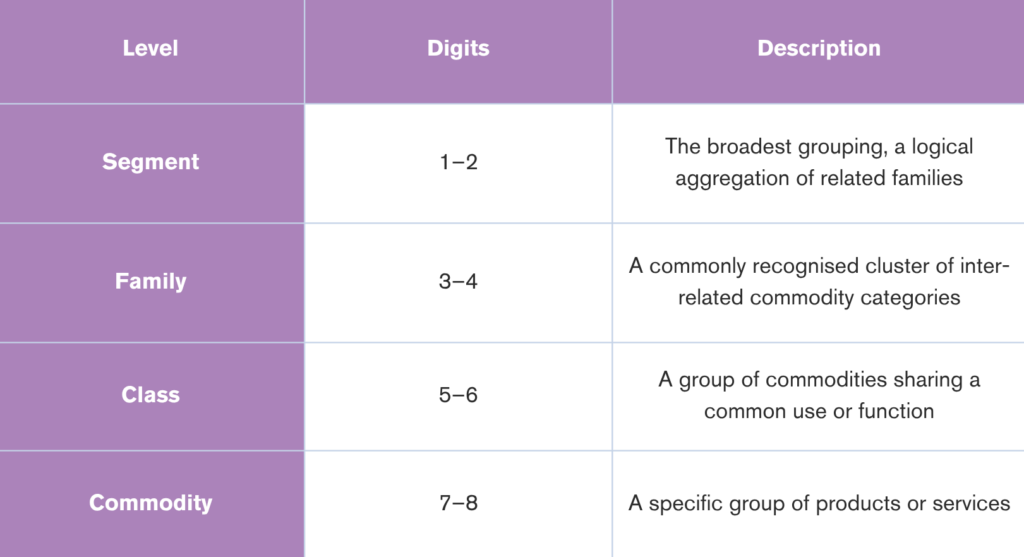
Each UNSPSC code is an eight-digit number organised into four hierarchical levels, each represented by two digits:
Example: Code 44121706
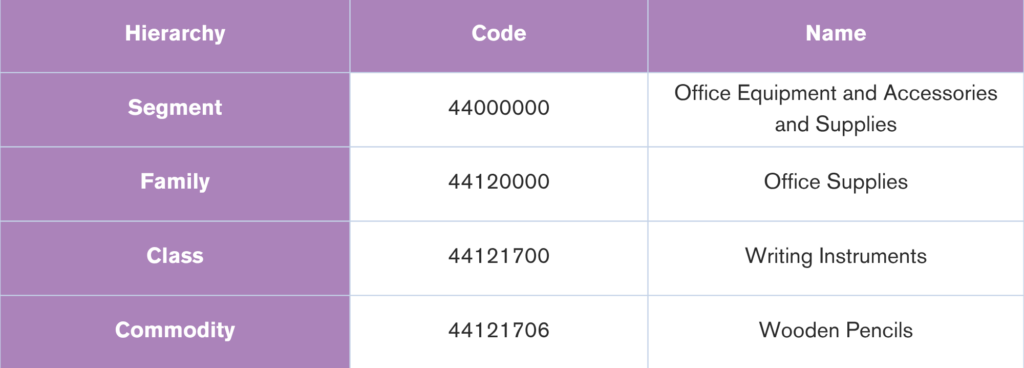
The hierarchical design means organisations can work at different levels of granularity depending on the purpose. Segment-level analysis gives broad category visibility; commodity-level classification supports more detailed reporting and benchmarking. Both are valid applications, the appropriate level depends on what the data needs to support.
How UNSPSC Codes Are Used in Practice
Spend Classification
The primary application is tagging transactions, purchase orders, or invoice lines with a UNSPSC code. This converts unstructured spend data: supplier names, free-text descriptions, GL codes, into a categorised dataset that can be aggregated, filtered, and analysed.
In large organisations with high transaction volumes, this classification is typically applied through automated tools rather than manually. Spend analytics platforms can map supplier and transaction data to UNSPSC codes at scale, though the accuracy of that mapping depends heavily on the quality of the underlying data and the logic applied.
Choosing the Right Level of Granularity
Different use cases call for different levels of the hierarchy:
- Segment or Family level is often sufficient for executive reporting and high-level spend dashboards
- Class level gives category managers a workable view without requiring exhaustive detail
- Commodity level supports benchmarking, market comparisons, and detailed sourcing analysis
A common issue in practice is inconsistency, where some spend is classified at segment level and other spend at commodity level, which makes aggregation unreliable. Defining a consistent classification policy across the organisation is a prerequisite for the data to be useful.
Benchmarking and External Comparisons
Because UNSPSC is a common standard, organisations can use it to compare their spend against external datasets, market pricing information, or industry benchmarks that reference the same codes. This is one of the practical advantages of using a widely adopted classification system rather than a purely internal taxonomy.
Supplier and Catalogue Management
Some supplier databases and e-procurement platforms use UNSPSC to classify the categories a supplier is qualified to serve, or to tag items within a purchasing catalogue. This allows buyers to search for suppliers or products by category using a common reference.
Suppliers occasionally assign their own UNSPSC codes to their products and services. These may not align with a buyer’s internal classification preferences, which can require reconciliation before the data is usable for analysis.
RFP and Contract Documentation
UNSPSC codes are sometimes included in tender documents to define the scope of what is being sourced, providing a standardised way to communicate category boundaries to potential suppliers. Some public sector procurement frameworks require UNSPSC classification as a mandatory field in procurement notices.
A Worked Example: Classification in Practice
Understanding the UNSPSC structure on paper is one thing, seeing how it plays out against real transaction data is another. The example below illustrates a common scenario: an organisation wants spend classified at L1 and L2 only, but the route to getting there is less straightforward than it might appear.
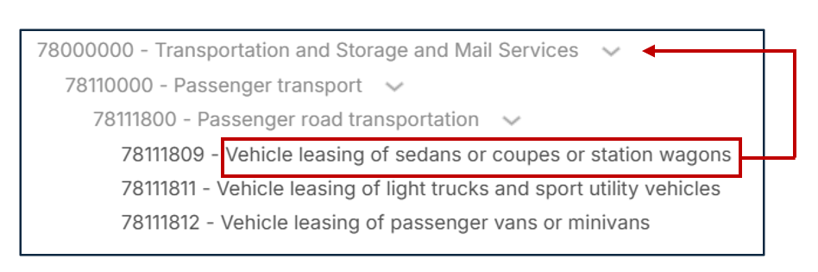
The transaction in question relates to ALD Automotive Ltd, a fleet management and car leasing company. The GL code reads “car leasing costs”, which sounds specific enough, but gives no clear signal about where in the UNSPSC hierarchy this spend belongs. There is no obvious, directly mappable L1 or L2 category sitting at the top of the tree that captures vehicle leasing cleanly.
The only reliable way to classify this correctly is to go into the full commodity tree, find the most accurate L3/L4 code, in this case 78111809, “vehicle leasing of sedans or coupes or station wagons”, and then derive the L1 and L2 classifications upward from there. The output is L1: Transportation and Storage and Mail Services, L2: Passenger Transport.
There are a few things worth taking from this example.
First, even when an organisation only needs high-level categorisation, the full depth of the UNSPSC tree may still be required to get there accurately. Skipping straight to L1 or L2 without interrogating the underlying codes risks misclassification, in this case, leasing costs could easily have been incorrectly filed under a financial services or facilities category based on the GL description alone.
Second, deriving L1 and L2 from the relevant L3/L4 code ensures the output is structurally consistent with the UNSPSC hierarchy. This matters because it keeps the door open for more granular classification later, if the organisation subsequently wants to analyse at a deeper level, the groundwork is already in place.
Third, this approach creates a repeatable methodology. Once the logic is established, consult the commodity tree, identify the most precise code, map upward, it can be applied consistently across all transactions, regardless of how ambiguous the source data appears.
Key Considerations Before Implementing UNSPSC
Consistency Across the Organisation
UNSPSC is only as useful as it is consistently applied. If different business units, systems, or data sources are using different versions of the code list, or interpreting codes differently, the resulting dataset will be fragmented. Establishing a clear policy on which version to use, at which level of the hierarchy, and how edge cases are handled is important groundwork.
Version Management
The UNSPSC is updated periodically, with new codes added and some deprecated over time. Organisations using a fixed version of the code list may find that it becomes outdated as new products, services, or categories emerge. Tracking which version is in use and reviewing it against updates is an ongoing maintenance consideration, not a one-time task.
Relationship to Internal Taxonomies
Many organisations already have internal commodity codes, GL account structures, or category hierarchies. UNSPSC may complement these, replace them, or run in parallel, but the relationship between the two needs to be explicitly defined. Mapping between an internal taxonomy and UNSPSC is rarely a clean one-to-one exercise, and ambiguity in that mapping will flow through to any analysis built on top of it.
Goods vs Services
UNSPSC was originally developed with products in mind, and while it does cover services, services classification is generally less precise. A supplier providing a bundle of services, say, both consultancy and implementation, may not map cleanly to a single commodity code. The further spend is from a physical, discrete product, the more judgement is required in classification, and the more inconsistency tends to creep in.
Data Quality as a Starting Point
Classification is applied to data that already exists. If the underlying spend data has inconsistent supplier names, vague transaction descriptions, or structural issues from multiple ERP systems, classification accuracy will be limited regardless of the taxonomy used. Data cleansing is typically a necessary step before UNSPSC classification can be applied reliably.
Use Cases by Function
Category Management
UNSPSC provides a structured basis for defining category boundaries and aggregating spend within them. This supports the baseline analysis that underpins category strategy work, understanding total spend in a category, the number and distribution of suppliers, the business units involved, and spend trends over time.
Where UNSPSC classification is applied consistently, it becomes a practical tool for opportunity identification: surfacing which categories are fragmented across too many suppliers, which are dominated by a single source, and which have seen spend growth that may warrant a sourcing review. This spend intelligence does not replace category strategy, but it informs it, helping category managers prioritise where to focus effort and build a defensible case for action.
The hierarchy also makes it easier to define category scope consistently across the organisation, reducing overlap between categories and ensuring all spend has a clear home.
Sourcing
In sourcing, UNSPSC codes support market research (since supplier databases and pricing benchmarks often reference the standard), scope definition in RFPs, and post-contract tracking to monitor whether spend is flowing to contracted suppliers as intended.
The link between classification and sourcing decisions is most direct at the opportunity identification stage. When spend data is classified consistently, it becomes straightforward to identify categories where the organisation is paying above-market rates, where contract coverage is low, or where a competitive tender has not been run in several years. UNSPSC classification does not make those decisions automatically, but it provides the structured data foundation without which those conversations are much harder to start.
ESG and Sustainability Reporting
Spend categories mapped to UNSPSC codes can be cross-referenced with external datasets on emissions factors, modern slavery risk, or other sustainability indicators. This allows organisations to identify which categories carry the most exposure and prioritise supplier engagement accordingly.
Mergers and Acquisitions
When two organisations combine, UNSPSC provides a common classification language that makes it possible to compare spend data across entities with different internal systems. This supports identification of duplicate supplier relationships, overlapping categories, and consolidation opportunities.
Direct vs Indirect Spend
UNSPSC codes apply across both direct and indirect spend, but the experience of using them differs significantly between the two. For direct spend: raw materials, components and other inputs that feed directly into a product or service, the taxonomy tends to perform well. Categories are generally discrete, suppliers are fewer, and the products being bought are well-defined enough to map cleanly to commodity-level codes.
Indirect spend is more complex. Categories such as professional services, IT, facilities, and marketing are harder to classify precisely, often span multiple UNSPSC branches, and frequently involve suppliers whose offering does not fit neatly into a single code. This is where classification inconsistency is most likely to emerge, and where the gap between the UNSPSC structure and how procurement actually manages spend tends to be widest. Understanding this distinction is important when deciding how much resource to invest in classification accuracy across different parts of the spend base.
Common Classification Pitfalls
Getting UNSPSC classification right in practice requires more than selecting a plausible code. Three pitfalls come up consistently in real projects.
The same product can sit in completely different branches depending on how it is bought
A coffee machine purchased outright belongs under equipment (48101505 – Commercial use coffee or iced tea makers). The same machine procured as a rental or managed service belongs in an entirely different segment (90101901 – Coffee machine and grinder rental and maintenance service). The correct code depends on the commercial arrangement, not just the product itself. Misreading that distinction understates spend in one category and overstates it in another, distorting any analysis built on top.
Classifying based on supplier name rather than what was transacted
A corporate purchasing card issued by HSBC might intuitively be coded under financial services or credit card providers (84141602 – Credit card service providers). But if the GL code shows “IT Licenses”, meaning the card was used to purchase software, the correct classification is Information Technology (43000000) at L1 and Software (43230000) at L2. Supplier name alone is unreliable. What matters is what was actually transacted, which is why GL codes and transaction descriptions must be interrogated alongside supplier data rather than treated as secondary.
Not going deep enough in the tree leads to the wrong higher-level codes
Locksmith services sit under Building and Facility Maintenance and Repair Services (72100000). But at a glance, the higher-level branch Specialised Trade Construction and Maintenance Services (72150000) might appear equally plausible. Without drilling to L4 (72101505 – Locksmith services) first and mapping upward, the L2 classification is wrong. This is the same principle as the vehicle leasing example: accurate high-level classification depends on getting the commodity level right first, not the other way around.
What these pitfalls have in common is that they are not random errors, they are predictable ones. They tend to occur when classification is treated as a quick data exercise rather than one that requires understanding of both the supplier relationship and the commercial context behind each transaction. Building a review process that catches these cases, particularly for high-value or ambiguous spend, is one of the most practical steps an organisation can take to improve classification quality over time.
What UNSPSC Codes Do Not Solve
It is worth being clear about what UNSPSC classification does not address on its own:
- It does not replace the need for clean, well-structured spend data. Applying codes to poor quality data produces poor quality analysis.
- It does not automatically generate category insight. Classification is an input to analysis, not an output. The value comes from what is done with the classified data.
- It does not always map well to how organisations actually manage spend. The UNSPSC hierarchy reflects a product and services catalogue logic, which does not always align with how procurement categories are structured internally or how markets are organised.
- It does not eliminate the need for human judgement. Ambiguous transactions, cross-category suppliers, and service-heavy spend categories all require decisions that no classification system can make automatically.
Understanding these boundaries is useful context for any organisation deciding how to implement UNSPSC and what to expect from it.
Summary
UNSPSC codes provide a standardised, globally recognised framework for classifying products and services. Their hierarchical structure supports analysis at multiple levels of granularity, and their widespread adoption makes them useful for benchmarking and cross-organisational comparisons.
In practice, their value depends on consistent application, clean underlying data, and clear alignment with how the organisation actually manages its categories. Where these conditions are met, UNSPSC classification can form a useful foundation for spend analysis and category management. Where they are not, the codes add structure without necessarily adding insight.
For procurement teams evaluating how to approach spend classification, understanding both the capabilities and the limitations of the UNSPSC is a sensible starting point.